
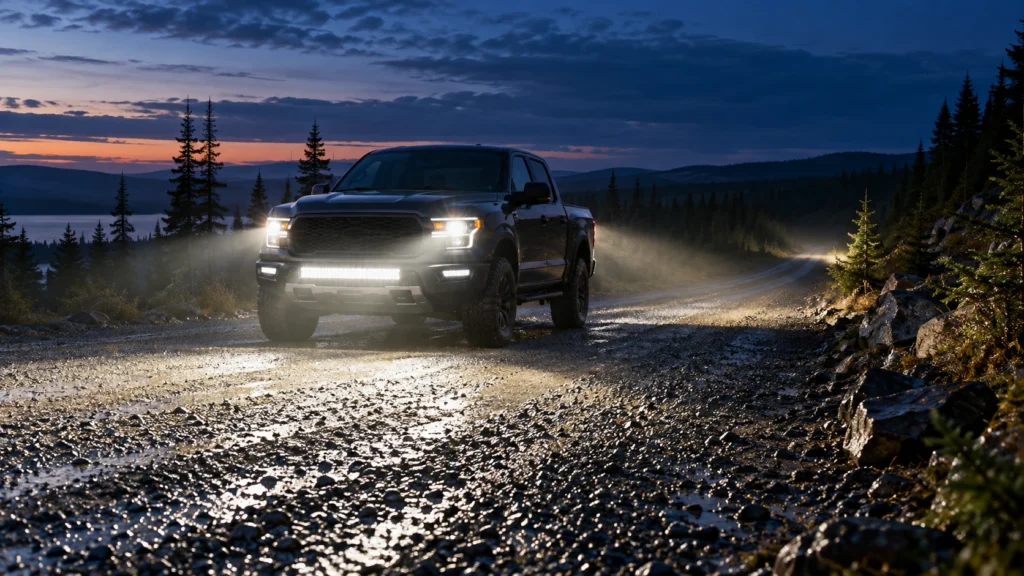
A vehicle light can advertise an impressive lumen figure and still leave the edges of a dark road poorly lit. Another light with fewer lumens may reach farther ahead because it concentrates its output into a narrower beam. Understanding lumens vs lux helps you read both specifications without mistaking either one for a complete description of what you will see.
What lumens and lux measure
Lumens describe the total amount of visible light a lamp emits. Think of them as a measure of output, regardless of where that light goes. A higher lumen figure can be useful when comparing lamps, but it does not tell you whether the beam spreads across a work area or focuses down a road.
Lux describes how much visible light reaches a surface: one lumen spread over one square metre equals one lux. For vehicle lighting, a lux figure usually refers to the illumination measured at a particular distance or location. That location matters. A lamp can produce high lux in the centre of a tight beam while providing much less light to either side.
This is why a lumen figure and a lux figure cannot be exchanged or ranked as though they measure the same thing. One describes the light leaving the lamp; the other describes the light arriving somewhere useful.
Read beam distance with its lux threshold
Driving light specifications often express reach as a distance at 0.25 lux, 1 lux, or 3 lux. Each threshold answers a slightly different question: how far from the lamp does the measured illumination fall to that level? Within the same product specification, the distance at 0.25 lux will be farther than the distance at 1 lux, because less light is required at the measurement point.
For example, a listed light bar may show 976 metres at 0.25 lux and 488 metres at 1 lux. Those figures describe two points on the same beam, not two operating modes. The longer number does not mean every object at that distance will be easy to recognise from a moving vehicle. Weather, road surfaces, mounting height, other lighting and your eyesight all affect what you can actually see.
When comparing two lights, use distances stated at the same lux threshold. A 0.25 lux distance for one lamp and a 1 lux distance for another are not a fair comparison. Also check whether the number applies to one lamp, a pair, or a complete kit, and whether it was recorded in a standard operating mode or a separate boost mode.
Beam shape explains the numbers
A focused spot beam puts more light toward the centre. It can deliver a long quoted reach without illuminating much of the roadside. A broader beam distributes light across a wider area, which can help reveal a bend, a verge or a nearby work zone. Spreading light over more space may reduce its intensity at any single distant point.
Consider two 20-inch driving light bars. One is listed at 22,984 lumens with a 976-metre reach at 0.25 lux; another is listed at 17,272 lumens and 1,300 metres at the same threshold. The lower-lumen bar has the longer stated reach. Its spot pattern concentrates light farther ahead, while the higher-lumen bar has a combined pattern intended to provide both width and distance. Neither number alone tells a driver which beam will suit a particular route.
A similar distinction matters off the road. If you are positioning a vehicle beside equipment at night, a very long, narrow beam may leave the area close to the doors or wheels dim. A broad work light may be more useful there, even when its distance figure looks modest.
Other specifications worth checking
Lumens, lux and reach are a starting point. Before choosing a vehicle light, read the surrounding specifications as a group:
- Beam pattern: Look for terms such as spot, broad, or combined, then inspect a beam image if one is available. Labels help, but the actual spread matters more.
- Operating mode: Some lights list output and reach in boost mode as well as a separate standard mode. Compare figures from modes you would actually use.
- Power and voltage: Wattage tells you about electrical demand, not how effectively the lamp places light on the road. Confirm that the stated voltage suits the vehicle.
- Physical fit: Check dimensions, mounting points, and available space. A bar with suitable output is little help if it obstructs another component or cannot be aimed properly.
- Connection and kit contents: Connector types differ, and a package may or may not include brackets, a relay set or the parts needed to obtain a high-beam control signal.
Colour temperature, usually expressed in kelvin, describes the light’s appearance rather than its reach. It can influence how the beam looks to you, but it should not replace a comparison of beam shape and measured illumination.
For more detailed information on this topic, read our guide on Why LED Warning Lights Matter for Roadside Safety.
A practical way to compare two lights
Start with the job. For unlit roads, decide whether you need more distance, more width, or a balance of both. For work close to the vehicle, pay particular attention to coverage near the vehicle rather than the longest advertised throw.
Next, compare the beam patterns and the distances measured at an identical lux threshold. Check the conditions attached to those figures, especially whether they refer to a single lamp or the whole arrangement and whether boost is active. Then examine the lumen output alongside wattage, fit, connector type, and included hardware. If beam photographs are provided, use them to judge the distribution that the headline numbers cannot show.
The most useful specification is the one tied to your task. Lumens tell you how much visible light the lamp produces; lux and beam distance indicate what reaches a measured point. Read those figures together with the beam pattern, and a large number becomes useful information rather than a shortcut to the wrong light.